How Ventric Health is Expanding Access to Early Heart Failure Detection
As reported in MedTech Strategist, March 2026
Heart failure is a complex clinical syndrome that evolves across stages and presents with diverse symptoms arising from multiple underlying causes. Yet one principle is universal: the earlier heart failure is identified and treated, the better the patient’s quality of life and long-term outcomes. Early detection is the mission of Ventric Health, whose FDA-cleared, office-based Vivio® System (Vivio) is designed to help primary care physicians identify and triage patients with early-stage heart failure—before structural damage and overt symptoms fully manifest.
Primary care clinicians are most likely to encounter patients harboring early, subclinical cardiac changes. Historically, however, they have lacked objective tools to identify such patients. Instead, clinicians rely on risk factors, comorbidities, and symptom reports—an approach complicated by overlapping complaints such as fatigue, dyspnea, or chest discomfort, if symptoms are reported at all.
Comorbid conditions in patients over age 65, for example, diabetes, sleep apnea, or chronic kidney disease, may prompt referral for echocardiography. Echocardiography is most informative in patients with heart failure with HFrEF, in which systolic pumping function is impaired. But roughly half of heart failure patients, however, have heart failure with HFpEF, a condition characterized by elevated filling pressures due to ventricular stiffness. In its earlier stages, HFpEF often lacks the structural abnormalities that echocardiography can detect. Ventric Health’s clinical data shows Vivio can identify physiological changes associated with both forms of heart failure. Related article: The Hidden Financial Drain of “Normal” Echoes: Why VBC Organizations Must Rethink Heart Failure Detection
Scientific Foundations
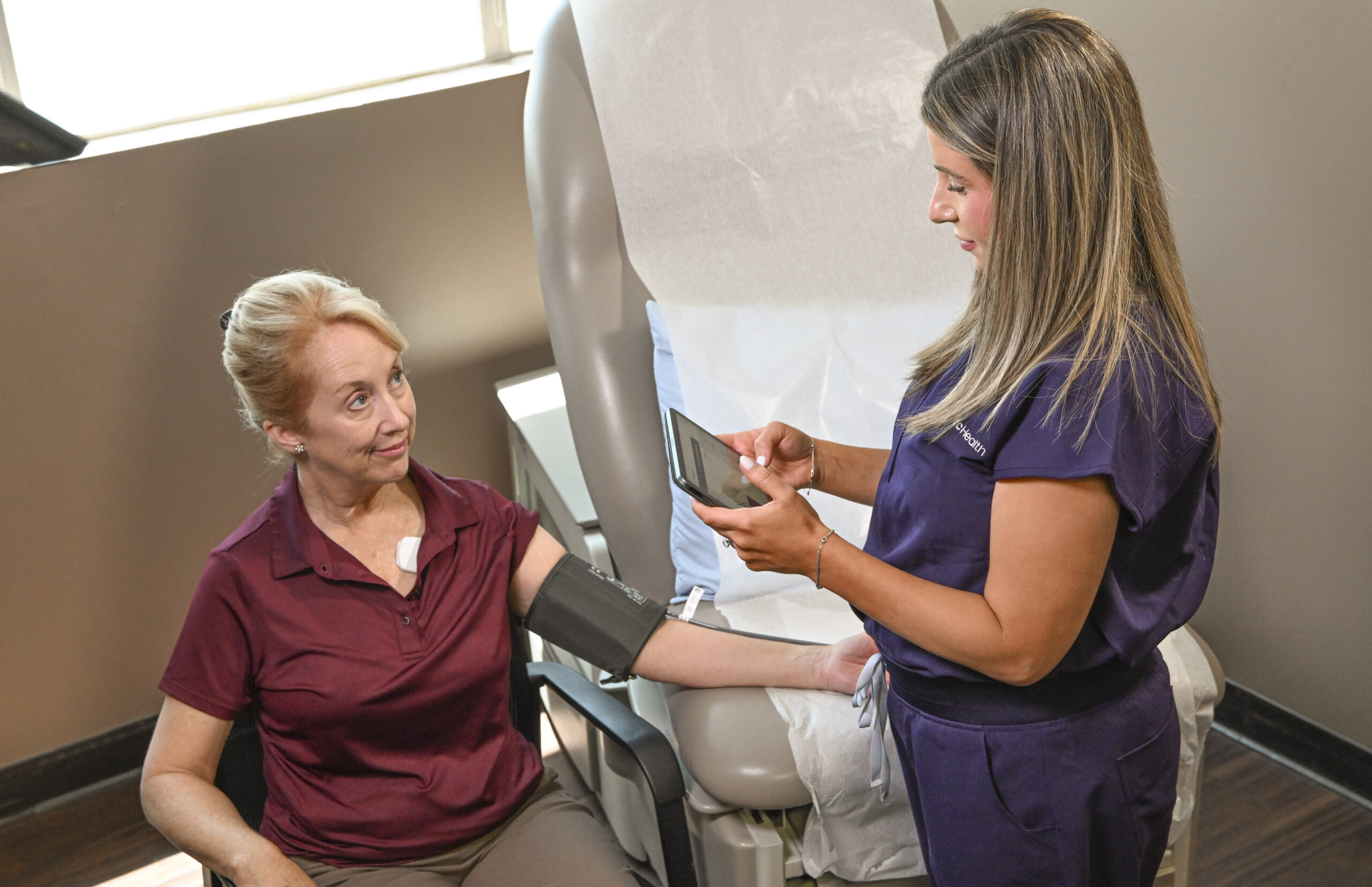
From the user’s perspective, the device resembles a conventional blood pressure cuff. Data streams to an iPad running the Vivio software, and results are returned within seconds via a cloud-based analysis. The workflow fits naturally into routine vital sign collection during patient intake.
Ventric Health was founded in 2014 by a team that includes CEO Sean Brady (a lawyer, who came to the company with experience in licensing intellectual property from universities and their investors); chief technical officer and Caltech engineering alum Derek Rinderknecht, PhD; Niema Pahlevan, whose Caltech PhD is in bioengineering and biomedical engineering; and Mory (Morteza) Gharib, PhD, the Hans W. Liepmann Professor of Aeronautics and Medical Engineering at Caltech. The company’s origins trace back to foundational research conducted in Gharib’s laboratory.
Gharib’s group studied cardiac embryology and fluid dynamics in zebrafish, a model organism widely used in cardiovascular research because its transparent body permits high-speed confocal imaging of cardiac function. The team discovered that in the earliest stages of development—before valves form—the embryonic heart pumps blood via elastic pressure waves traveling along the heart tube. These waves create dynamic suction that drives flow. Importantly, elements of this primitive pumping mechanism persist in the mature heart.
The researchers further demonstrated that waveforms generated by this phenomenon could be measured noninvasively. The founders recognized that heart failure, particularly the elevation of filling pressures, represented a compelling clinical application.
Targeting LVEDP
The team focused on estimating left ventricular end-diastolic pressure (LVEDP), widely regarded as a physiological hallmark—and one of the earliest signs of heart failure. Elevated LVEDP reflects impaired ventricular function and the inability of the heart to meet systemic demands in the setting of increased filling pressures. These pressure elevations often precede structural remodeling and clinical symptoms.

Historically, LVEDP measurement required invasive left heart catheterization or implantable sensors. Vivio estimates LVEDP noninvasively.
The system includes a modified pneumatic blood-pressure cuff applied to the upper arm, a synchronized single-lead ECG, and an electronics module. After obtaining standard brachial blood pressure measurements, the cuff reinflates to suprasystolic pressure and records approximately 40 seconds of brachial pulse waveform data synchronized with ECG signals. The exam takes about five minutes.
Brady emphasizes that the approach is physics-based rather than a “black-box” machine learning system. Using a three-parameter cardiovascular model reflecting preload, afterload, and contractility, the system reconstructs left ventricular pressure dynamics to estimate LVEDP.
Vivio received FDA 510(k) clearance in October 2023. A validation study published in the Journal of the American Heart Association in December 2025 compared Vivio’s estimates with invasive LVEDP measurements obtained during left heart catheterization using high-precision Millar catheters. The invasive cohort included 407 patients undergoing non-emergent catheterization; 321 healthy participants served as controls.
Vivio identified elevated LVEDP (>18 mm Hg) with a sensitivity of 80% and specificity of 83%. This performance is particularly relevant for HFpEF, where conventional diagnostics—including BNP (B-type natriuretic peptide) testing and echocardiography—may lack sensitivity in early disease.
Real-World Implementation
A separate real-world study published in the Journal of the American College of Cardiology (JACC) in July 2025 evaluated Vivio screening across three primary care practices. Among 2,040 patients without prior heart failure diagnosis—but with diabetes, chronic kidney disease, or clinical suspicion—38.5% tested positive (LVEDP >18 mm Hg).
Results of the Vivio real-world study suggest that it can find many patients that might otherwise have remained undiagnosed until at a more advanced stage of disease.
 Patients also completed the KCCQ-12 questionnaire to assess symptom burden and functional status. Among those with positive findings, more than one-third were asymptomatic (Stage B heart failure), approximately 42% were New York Heart Association (NYHA) Class I, and about 27% were NYHA Classes II-IV, the latter living with substantial symptoms and impaired health status associated with higher risks of heart failure hospitalization and death. These results suggest many patients might otherwise have remained undiagnosed until at a more advanced stage of disease.
In practice, says Brady, “If patients come back positive, you can run through the KCCQ-12 questionnaire to assess symptom burden to determine if they are really sick, asymptomatic, or somewhere in the middle. It allows primary care providers to institute workflows, including the initiation of guideline-directed medical therapy and specialty referral at the time of diagnosis.” Primary care practices are often quite comfortable managing patients in the asymptomatic or mildly symptomatic stages of heart failure, but they would otherwise refer the patient for a near-term cardiology visit so they can access more advanced care. Related research: Clinical Evidence for the Vivio System
A Population Health Tool
Up to half of heart failure patients remain undiagnosed, and many Medicare beneficiaries receive their first diagnosis during an emergency room visit or hospitalization. Delays in recognition contribute to avoidable costs and morbidity.
Vivio is positioned as a population health tool—deployable in primary care settings to identify at-risk individuals during routine visits. Early detection enables timely initiation of therapies, including SGLT2 inhibitors and aggressive blood pressure management, which have demonstrated outcome benefits across heart failure phenotypes.
For health systems operating under value-based care arrangements, earlier diagnosis may translate into reduced hospitalizations and improved quality metrics. Brady estimates that about 70% of Medicare is under value-based arrangements, across Medicare Advantage, the Medicare Shared Savings Program, or Accountable Care Organizations, for example. “CMS is rolling out new models all the time, and its goal is to transition Medicare to 100% value-based arrangements by 2030.” Going forward, an increasing number of patients will be under these arrangements.
Ventric Health operates under a per-test revenue model, providing devices and training at no additional cost—an approach designed to align with value-based organizations. “There is no up-front cost, and they’re able to use it on an ongoing basis to see how it impacts their practice,” Brady says.
Reframing Heart Failure
Heart failure is often perceived as a late-stage condition marked by edema, dyspnea, and recurrent hospitalizations. But it is a progressive disease that begins months—or years—before overt decompensation.
Reframing heart failure as a condition that can be detected and treated earlier is central to Ventric’s thesis. Early physiological identification offers the possibility of intervening before irreversible remodeling occurs.
As Vivio enters broader clinical use, anecdotal reports describe patients who, after positive screening and initiation of therapy, return with improved symptoms—sometimes only then recognizing how much their baseline had shifted over time.
This scenario is emblematic of the challenges of diagnosing elderly people who have many co-morbid conditions; subtle declines often go unnoticed. Brady says. “They adjust, and they just expect to have these things happening, but you really can take care of them.”
Objective physiological assessment may help restore visibility to a disease that too often advances quietly.
Non-invasive. Point-of-care. Gold-standard accuracy.

What previously required a catheterization lab now takes less than five minutes in the exam room.